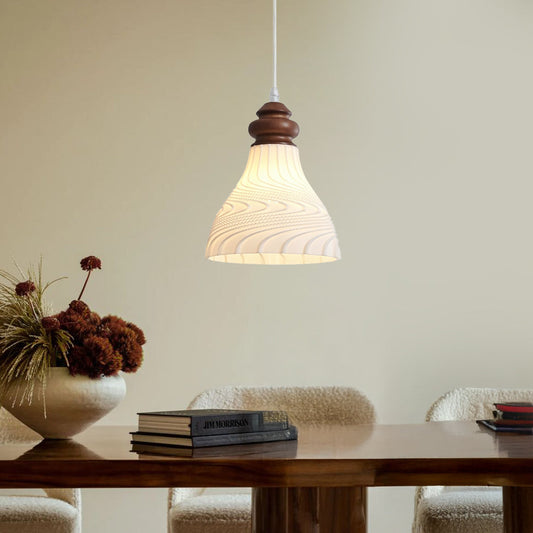
For a low ceiling, start with a flush or semi-flush fitting unless you have generous clearance and a pendant is deliberately positioned away from the main walking route. The right choice depends on usable headroom, the room's proportions and how much visual presence you want overhead.
Measure the space that matters
Measure from the finished floor to the lowest part of the ceiling, including beams, coving and changes in level. Then measure the fitting itself, including its ceiling plate, shade and any stem. A room can feel cramped when the fitting technically fits but sits close to a door swing, stair route or seating sightline.
Use the most demanding route as your reference. In a hallway, that is the walking path. In a bedroom or living room, consider where people stand, reach for storage or move between furniture. A ceiling point does not automatically make a pendant practical.
Choose the right fitting profile
Flush fittings sit close to the ceiling and are usually the calmest option when headroom is limited. Semi-flush designs add a small drop and can give more decorative depth without the long suspension of a pendant. A pendant can still work in a low room when it is compact, placed over a table or another area where people will not pass underneath, and sized with the clearance confirmed first.
Do not choose by style alone. Check the side profile, lowest point and how the shade directs light. A broad diffuser may spread light gently; a deeper shade may create more contrast but feel heavier overhead.

Balance diameter and visual weight
A fitting can be low enough yet still look oversized. Compare its diameter with the room width, nearby furniture and the ceiling visible around it. In a small room, a wide but shallow diffuser may feel calmer than a narrow fitting with a deep shade. In a longer room, two modest fittings can distribute attention more evenly than one centrepiece, provided the existing wiring and support can take the arrangement.
Check the installation before buying
Before ordering, confirm the ceiling fixing method, the condition of the existing mounting point, the fitting weight, the bulb or integrated-light specification and whether the light is suitable for the room's environment. These are selection checks, not DIY wiring instructions. Ask a local qualified electrician to confirm wiring, structural support and compliance, especially when replacing a heavy fitting or working near a stair, bathroom or other demanding location.
Your final choice should leave a clear route, suit the room's scale and provide the light distribution you actually need. If the clearance, support or electrical details cannot be verified, rule out the fitting until the retailer or electrician confirms them.